*본문은 《2025 Platform-L Live Arts Program》 도록에 수록되었음.
플랫폼엘
platform-l.org
윤태균(독립 큐레이터)
언제부터인가 컴퓨터는 인간에게 단순한 도구가 아니게 되었다. 금융, 제조업, 행정은 컴퓨터에 의해 자동화된 지 오래다. 인간은 알고리즘을 업데이트하고 피드백 사이에서 발생하는 버그를 점검한다. 이분법적으로 생각하자면 인간이 컴퓨터에 의해 도구화된 풍경일 테다. 이제는 ‘컴퓨터’라는 용어를 사용하기에도 개념적 오차가 발생한다. ‘연산 기계’로서 컴퓨터의 기능과 작동은 이제 상품으로서 하드웨어 개체를 넘어 거대한 현실의 추상태에 안착한다. 이 추상태는 인터넷과 웹이라는 전산망의 총체일 뿐만 아니라, 그것의 사용자이자 데이터의 트랜스듀서(변환 장치)인 인간의 인식 체계-자본주의까지 포괄하는, 즉 말 그대로 현실의 작동 기제이다. 우리에게 드러나는 시공간은 고정적인 (물러난) 실재가 아니라, 우리가 살아가는 구체적 추상의 무대이다.
예컨대, 안나 그린스팬(Anna Greenspan)은 인간의 시간 개념이 그레고리력에서 ‘0000-00-00’을 사용하는 사이버력으로 대체되었다고 말한다. 자본주의하에서 시간은 추상적이고, 세속적이며, 균질적이고, 양적이며, 자율적인 시간 모드로 발전했다. 이러한 시간은 금융 시스템과 전 세계적인 교역로를 지원하기 위해 정확하게 동기화되고 표준화되어야 했고, 특히 사이버 공간은 이러한 표준화의 필요성을 더욱 절실하게 만들었다. 사이버 공간에서 자본의 흐름은 디지털 코드에 불과하며, 시간과 돈은 하나의 수치적/기술적 평면 위에서 수렴하게 된다.
이처럼 알고리즘과 프롬프트 스택은 오늘날 현실의 주요한 프레임워크이다. 그렇기에 당연히, 평면 위 인간의 인지가 접힘으로써 실현되는 예술의 영역 또한 마찬가지일 것이다. 간단한 예를 들어보자. 시각 작업을 할 때에 일반적으로 사용되는 어도비(Adobe)의 프로그램, 캐드(CAD), 스케치업(Sketchup), 라이노(Rhino)와 블렌더(Blender), 그리고 이 글의 주요 대상으로 등장할 슈퍼콜라이더(SuperColider)까지. 프로그램이 제공하는 인터페이스와 기능들은 작업의 방향을 통제하고 유도한다. 인간과 프로그램은 서로를 정향함으로써 결과물을 도출하게 된다. 이는 기계와 인간이 벌이는 단순한 주권 투쟁이 아니다. 여기서 주권은 서로에게서 빼앗는 것이 아니라 개발해야 하는 무언가이다. 그리고 이 개발은 인지의 확장을 통해 가능하다.
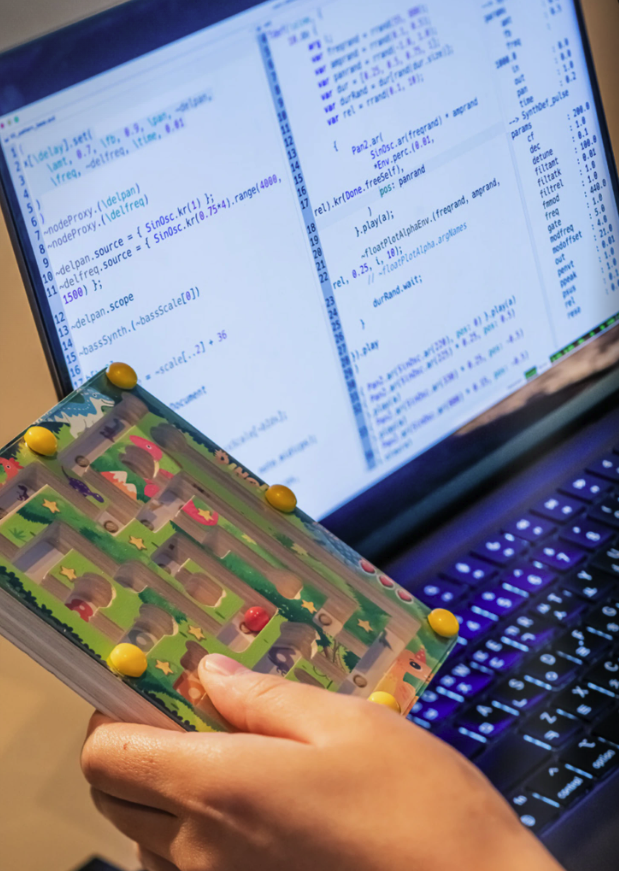
박다희의 렉처 퍼포먼스는 알고리즘 작곡 소프트웨어인 슈퍼콜라이더를 주요한 교각으로 삼는다. 이 피드백 루프의 노드는 다음과 같다.
슈퍼콜라이더: 프롬프트 인풋(input)-연산-사운드 송출
박다희: 사운드 지각-피드백을 통한 다음 프롬프트 입력-(관객들을 향한) 자연어로의 설명
이 루프에서 분명한 점은 박다희와 슈퍼콜라이더가 사용자-도구의 관계가 아닌 하나의 인지 과정에서 상호 접속하는 관계에 있다는 것이다.
전통적인 인지과학의 인지 모델은 인간의 뇌 내 과정만을 인지 과정으로 삼지만, 앤디 클라크(Andy Clark)는 인지의 작동 피드백 루프에 작용하는 모든 요소와 과정을 인지 과정의 일부로 본다. 외부의 인식적 행동은 내부의 인지 과정과 동일한 계산 구조를 공유하기에, 인지적 동등성을 가진다는 것이다. 따라서 슈퍼콜라이더와 박다희의 관계는 주인-노예의 위계에 속하지 않고 상보적인 인지과정 내 노드의 관계, 빗대어 말하자면 협주하는 앙상블 단원의 관계에 놓인다. 그러나 분명 이 협주의 설계와 구조의 즉각적 갱신을 담당하는 프로세서가 있을 테다. 그 역할은 (당연하게도?) 비판적 이성으로서 박다희가 실행한다. 박다희의 의식적 내용은 목표 대상 및 행동 유형을 선택하는 '관리자' 역할을 하고, 컴퓨터의 미세한 운동 제어는 독립적인 실행을 담당한다.
갱신되는 프롬프트와 코드는 악보, 그리고 연주하는 오토마타(자동기계, automata)로 동시에 기능한다. 그러나 전통적 연주에서 연주자의 두개골에 감춰져 있던 음악의 스키마, 그러니까 리듬, 스케일, 화성은 컴퓨터 디스플레이 인터페이스에 적나라하게 드러난다. 이 오토마타는 블랙박스가 아니라 파열된 회로이다. 회로는 외부의 수많은 노드와 접속하며 엣지(edge)-관계를 형성한다. 공연장의 분위기와 관객의 반응, 그리고 미결정된 연주의 잠재성까지. 시공간 내에 참여한 모두가 하나의 회로로 통합되며, 이 기이하고 은밀한 협연은 예술에서의 자동화와 비판적 이성 사이 새로운 주권 형식을 실험하는 장이 된다.
The Calculating Soul: On the Circuit of Expanded Expression
Taegyun Yoon
Independent Curator
At a certain point in time, the computer ceased to exist as a utilitarian tool for humans.
Finance, manufacturing, and administration have long been automated by computers,
leaving humans to update algorithms and check for bugs that arise in the intervals of
feedback. From a binary perspective, humanity itself seems to have become
instrumentalized by computers; even the very term “computer” now entails a conceptual
misalignment. The function and operation of this “machine of computation” have outgrown
the confines of hardware as a commodity and have taken shape as a vast, abstract modality
of reality itself. The abstract state refers both to the totality of computerized networks,
including the Internet and the web, and, in a literal sense, to the mechanism of reality as
mediated from human perception, with individuals functioning concurrently as users and
transducers (or transition devices) of data, to capitalism. The spatiotemporal world is no
longer a static or (hidden) reality but a stage of concrete abstraction on which our lives
continuously unfold.
According to Anna Greenspan, our conception of time has migrated from the familiar cycles
of the Gregorian calendar to the cyber-temporal rhythm of “0000-00-00.” Under capitalism,
time has evolved as an abstract, secular, homogeneous, quantifiable, and autonomous
mode in the temporal regime. To sustain global networks of finance and trade, it became
imperative to synchronize and standardize its logic with precision—a necessity intensified by
the growing influence of cyberspace. Furthermore, within the digital domain, the flow of
capital remains solely as encoded signals, and time and money merge into a unified
numerical and technical plane.
In the same vein, algorithms and prompt stacks function as the underlying framework of contemporary reality, a truth that becomes visible in art as human perception folds itself
upon abstract layers. Examples can be seen in the digital instruments of visualization: Adobe
programs, CAD, SketchUp, Rhino, Blender, and notably SuperCollider, which will be
examined in the second half. The interfaces and functionalities of these programs guide and
shape the direction of artistic work. Humans and software, in turn, orient one another to
produce outcomes. This interaction is not a struggle between human and machine for
dominance, as sovereignty is not something to seize but instead a capacity to be cultivated
together. And its progress demands the broadening of perception.
The lecture-performance by the artist Dahee Park employs SuperCollider, a platform for
audio synthesis and algorithmic composition, as a central nexus. The nodes of this feedback
loop can be outlined as follows:
SuperCollider: Prompt input → computation → sound output
Dahee Park: Sound perception → next prompt input via feedback → delivery in natural language to the audience.
In this loop, it becomes evident that Park and SuperCollider do not inhabit a simple user-tool
dynamic but rather stay together as components of a single, intertwined cognitive process.
Unlike traditional cognitive science, which confines mental faculties to discrete regions of the
brain, Andy Clark envisions that cognitive networks extend across all elements and
processes that participate in feedback loops of thought. In other words, external perceptual
actions mirror the same computational structures as internal cognitive processes, thereby
achieving a form of cognitive equivalence. Under this paradigm, the relationship between
SuperCollider and Dahee Park does not operate within a dominant–subordinate hierarchy
but as an assemblage of nodes engaged in complementary cognitive processing, akin to
members of a performing ensemble. Still, a performance may require a processor
responsible for immediate recalibration and updates of its design and structure. Here, those
tasks (unmistakably?) fall to Park as a form of critical intelligence. Her consciousness
performs as the “operator” that defines targets and action parameters, whereas the
computer executes the motor control with a precision all its own.
The continuously updated prompts and code serve simultaneously as a musical score and
as the performing automata. Yet, in contrast to conventional performance, the musical
schema, including rhythm, scale, and harmony, once concealed within the cognitive interior
of the performer, is laid bare on the computer display interface. This abstract machine is not
a black box but a ruptured circuit through which innumerable external nodes link to form
edge relations. The atmosphere of the performance hall, audience reactions, and even the
latent potential of an undecided performance draw all participants within this spatiotemporal
field into a single circuit. This eerie and covert collaboration transforms into an experimental
ground for a new format of autonomy between automation and critical intelligence in art.
'비평' 카테고리의 다른 글
| 경계의 양가성에 관하여: 주다은 개인전 《흩어진 기별》 리뷰 (0) | 2026.01.02 |
|---|---|
| 관측과 사변 사이, 서정(抒情): 이수진 개인전 《폴리포니 클럽: 몬더그린 확장본》 (0) | 2025.12.20 |
| 초월적 기계에 관하여 1: 현실 너머의 에로티즘 기계 (0) | 2025.10.04 |
| 디오니소스적 퓨쳐리즘(Dionysian Futurism) Ver. 2 (0) | 2025.08.04 |
| 피에르 위그 《리미널》 REVIEW: 외상과 역치의 (역)현실에서 (0) | 2025.08.02 |


